
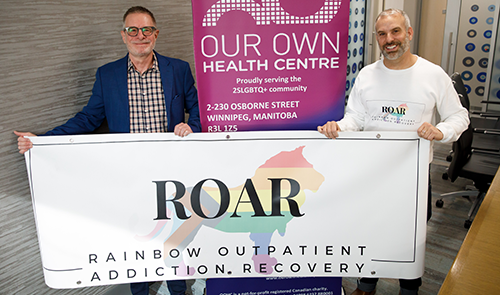
Addiction is a struggle. It can be even more so when standard treatment programs do not account for a central aspect of a person’s identity.
With support from Manitoba Liquor & Lotteries (MBLL), ROAR (Rainbow Outpatient Addiction Recovery) is a ground-breaking treatment program addressing substance misuse for the 2SLGBTQ+ community. In Winnipeg, it’s the first and only such addictions treatment program just for this community.
“One of the most important things is talking about sexuality and sexual behaviours – a lot of addiction treatment programs don’t delve into that aspect,” said JP Grimard, who created and runs the program.
“ROAR combines evidence-based treatments with culturally relevant topics. For example, internalized homophobia, internalized transphobia, the effects of coming out, and dealing with coming out not only as queer but also a person with an addiction.”
A registered clinical counsellor with a master’s degree in counselling psychology, Grimard based ROAR on a successful program he led while working with Vancouver Coastal Health.
In Vancouver he crafted a 16-week outpatient program with a focus on methamphetamines for two at-risk groups: unhoused youth and men who have sex with men. It morphed into a program for all substance abuse, including alcohol and cannabis, for the queer community in general.
Grimard lived on the West Coast for decades before returning to Winnipeg, his hometown, in 2021. At a gathering of mutual friends, he met Bryan Magwood, president of Our Own Health Centre (OOHC). OOHC is a clinic and registered charity for the 2SLGBTQ+ community, with care providers and a board from that same community, that operates out of the LifeSmart Health Clinic in the city’s Osborne Village.
They agreed Winnipeg was due for a program just for the 2SLGBTQ+ community.
Magwood secured funding from the Winnipeg Foundation for OOHC to launch a ROAR pilot in 2024. Grimard took what worked in Vancouver – the program by then was more than 15 years old – and updated it for Winnipeg.
Group sessions are a vital component of ROAR, said Magwood, who is also an emergency doctor at Children’s Hospital.
“Often, when a 2SLGBTQ+ person previously found themselves in a group situation, they might have been the only one from that community,” said Magwood. “Since they’d have already experienced a degree of discrimination, it’s like they had to go back into the closet. ROAR offers a safe space for members to express themselves.”
Maia Graham-Derham, a social responsibility consultant with MBLL, saw a natural fit between MBLL and ROAR.
“It’s important for MBLL to support programs and services that serve and reflect all Manitobans. Seeing a program focusing on the 2SLGBTQ+ experience and strengths of that community, while also addressing problematic substance use, was so encouraging. The partnership exemplifies what it means to be ‘good together’ for Manitobans’ quality of life.”
Grimard and a program facilitator, Mercedes Rohr, are ROAR’s frontline staff. OOHC looks after finances, supplies, printing, and administrative support.
Initial funding from MBLL this past year enabled ROAR to run a full 16-week session for 10 people. With funding secured for a second year, ROAR has run two more sessions. A fourth session got underway the second week of September.
“We’re beyond thrilled MBLL came on board because we’re offering an expanded version of the program,” said Grimard. “We can provide bus passes because transportation can be a barrier. Funding helps with a meal program, recreation therapies, a staff member, extra after-care, and one-on-one sessions.”
A key aspect of the program is feedback-informed treatment (FIT). It’s an evidence-based tool used in clinical settings to track a client’s progress during an episode of care. Client self-report weekly on how they are faring along four different scales. They see a striking visual of their progress, or where they’re at risk of not achieving their goals.
Anonymized statements from two clients speak to ROAR’s effectiveness.
“I have a way better understanding of my addiction and why I was misusing substances… I’ve grown so much and have gained a sense of peace.”
“I feel pretty alienated from the community, so connecting with fellow addicts who were also not straight is meaningful and makes me feel like I belong.”
ROAR has earned national recognition for filling a big gap in addictions treatment. The Dollar A Day Foundation awarded ROAR its Changemakers award for new or innovative programming in the treatment of addiction and mental health.
And through social media and by taking part in Winnipeg’s Pride parade, ROAR is building a valuable sense of belonging for clients. ROAR at the Pride Winnipeg parade on June 1, 2025.
“Grads from all three groups came to Pride,” said Grimard. “They support each other behind the scenes in ways we can’t as a clinical group.”
“There’s a saying: addiction wants you alone in a room so it can kill you. A lot of people come out of addiction quite isolated. They’re rebuilding friendships and relationships that are supportive of their recovery journey.”
For more information visit www.roarrecovery.com.
*******
#MBLLGoodTogether demonstrates Manitoba Liquor & Lotteries’ (MBLL) commitment to partnering with Manitoba communities, non-profits, and charitable organizations that help make our province an even better place to live. Our Community Champion series highlights MBLL employees that are making a difference in the lives of Manitobans through their work or volunteer efforts in the spirit of being “good together.”